by Ben Elowitz

This article originally appeared as a feature at AllThingsD.

We all read the statistics every week documenting the meteoric new growth areas of the Internet, and they are impressive:

Online video is exploding, with annual user growth of more than 45 percent.  Mobile-device time spent increased 28 percent last year – with average smart-phone time spent doubling.   And social networks are now used by 90 percent of U.S. Internet users – for an average of more than four hours a month.

None of this is a newsflash.  Every venture capitalist, Web publisher, and digital marketer is hyper-aware of these three trends.

But what’s happening to the rest of the Web?
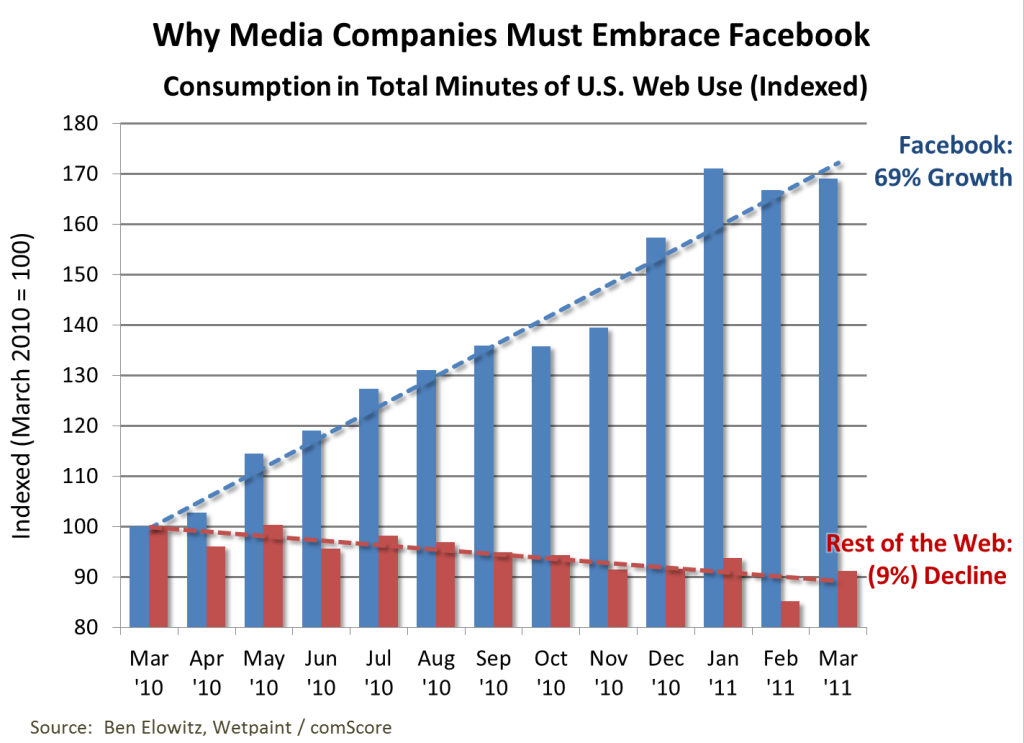
The Web Is Shrinking - Elowitz/Wetpaint

The Web Is Shrinking.  Really.

When you take these three growth areas out of the picture, the size of the hole left behind is staggering:  the rest of the Web – the tried and true core that we thought would have limitless growth – is already shrinking.

Here are the facts:

When you exclude just Facebook from the rest of the Web, consumption in terms of minutes of use shrank by nearly nine percent between March 2010 and March 2011, according to data from comScore.  And, even when you include Facebook usage, total non-mobile Internet consumption still dropped three percent over the same period.

We’ve known that social is growing lightning fast – notably, Facebook consumption, which grew by 69 percent; but now it’s clear that Facebook is not growing in addition to the Web.  Rather, it’s actually taking consumption away from the publishers who compete on the rest of the Web.

And just what is the rest of the Web?

I have been calling it the “document Web,” based on how Google and other Web architectures view its pages as documents, linked together. But increasingly, it might as well be called the “searchable Web” since it’s accessed predominantly as a reference, and navigated primarily via search.

And it’s becoming less relevant.

In the last year, Facebook’s share of users’ time online grew from one out of every 13 minutes of use nationwide, to one out of every eight.  In aggregate, that means the document Web was down more than half a billion hours of use (that’s more than 800 lifetimes) this March versus last March.  And in financial terms, that represents a lost opportunity of $2.2 billion in advertising inventory that didn’t exist this year.

The Creation of a New, Connected Web

The change in the Web’s direction is a clear indication to me that we aren’t just in the midst of a boom for new interaction modes, but rather a generational overhaul of the Internet.

What replaces the declining searchable Web is a new and “fully connected” digital life.  You may have heard this before.  After all, the promise of the Web was to connect pages with hyperlinks.  Well, this time, “connected” means much more.  It means the Web connects us, as people, to each one of the individuals who’s online; and those connections, ultimately, extend from one of us to all of us.

Just as significantly, this all happens in real-time, and at nearly all times.

And here’s what’s different when you connect people, as opposed to pages: Now, the Web knows who we are (identity); is with us at all times wherever we go (mobile); threads our relationships with others (social); and delivers meaningful experiences beyond just text and graphics (video).

The connected, social Web is alive, moving, proactive, and personal; while the document Web is just an artifact – suited as a universal reference, but hardly a personal experience.

The Social Web Versus the Searchable Web

Analytical explanations – increasing smart-phone penetration, bandwidth availability, and technology sophistication – fill in some of the gaps as we try to understand this sea change, but they fall short.

Something larger is afoot, and it’s not about science or technology.  Rather, as human beings, we have changed how we fit the Internet into our lives.

And the nature of the Web is changing to match. The old searchable Web is crashing; while the new connected, social Web is lifting off.

The implications for publishers are massive.

The last decade has been defined by the rise of Google as the nearly limitless supplier of traffic to digital media properties.  And so a generation of digital media publishers developed and followed the same playbook:  create lots of content around top keywords; engineer for search engine optimization (SEO); and expand the surface area in search engines to reach more users.  The objective was to catch visitors in their net; expand reach – as measured by ComScore; look more impressive to advertisers; and capture more demand.

The landscape is changing, and fast.

SEO’s strategic value is quickly fading as Google’s growth slows and its prominence in distribution slides away.  In its place, Facebook has become the wiring hub of the connected Web – a new “home base” alternative to Google’s dominance of the last decade.  Facebook began receiving as many visits as Google in March 2010, and already garners more than three times as many minutes as Google each month from users, according to comScore.  Looking ahead, the best projections of U.S. online reach indicate that Facebook will surpass Google on that metric in less than a year, too.

And with this change, the nature of the relationship between users and publishers is being altered fundamentally – and perhaps forever.

Search offers a utility relationship, connecting users to content for the briefest of transactions; typically, it provokes users to just one page-view so they can find a piece of information, and then they move on.

But social discovery builds a relationship.  Leveraging social endorsements and an environment of serendipitous discovery, consumers meet publishers in a meaningful context. As a result, the relationship that forms is stronger – and, more importantly for publishers, it’s branded.

Unlike the ecosystem set up by Google, where the search engine ironically intermediates between users and the objects of their queries (so that users reinforce their loyalty to Google, far more than to the publisher), in the world of social publishing, the Facebook hub enables a direct, if constrained, relationship between users and media brands.

The results – at least for my own company, Wetpaint – are that social media brings more qualified eyeballs and retains them.  People who come via social media stay longer on the first visit; and they are more likely to come back sooner and more frequently.  Overall, our visitors from social networks have a relationship that’s several times stronger – and several times as valuable when measured in engagement, page-views, and revenues – than the relationships people form when then arrive through search.

The Human Connection

But it’s not just a change in mechanics.  It’s a change in our human relationships.

Lewis D’Vorkin, the Chief Product Officer at Forbes, speaks of it when he and Alex Knapp talk about “live” media, quantum entanglement and mutually rewarding relationships that bind authors and readers on the new connected Web.  It’s a sense of the Web moving from static published reference to living digital companion.

But there’s even more, and this vast change foreshadows bigger and better impacts on our lives.  The greatest innovators in social media are driving along exactly that edge today.   As one friend commented recently on the full potential of connected lives, by being joined more closely together, we can increase empathy and meaning, while decreasing isolation.

Toward a Fully Connected Future

Admittedly, we’re early in the replacement cycle when it comes to the connected Web. Even for strong connected Web performers like Huffington Post, my own company, Wetpaint, and others, the sum total of traffic from Facebook, Twitter, video, and mobile may add up to only half the total, or less.

But the trend has tipped; and with that tip has come both the business necessity and the human impact potential of elevating the relationship.

As the document Web of old shrinks, the new connected Web expands and delivers experiences that make our time online more effective, efficient, and enjoyable.

And that changes the role of companies on the Web from mere content publishers or providers to truly connected digital partners for real people.

  • http://www.lindenbook.com Jürgen Messing

    Looks like a trend. But it takes less than 10 years and we will see a pivot. Law of cycles.

  • http://www.facebook.com/people/Kelly-Smith/573153409 Kelly Smith

    Very thoughtful article and certainly relevant to some of the things we're thinking about at Zapd.  Thank you for taking the time to write this.

  • http://www.wealthvisor.com Chip Treverton

    Great analysis, Ben – even if still in the early stages (when looking at total consumption of US web use), on a percentage basis this really makes a good case for how thing are changing…and quickly

  • http://blog.redfin.com GlennKelman

    Awesome article! And something I've wondered about many times before… 
    Ben, is the 9% drop:
    a. a drop in folks browsing non-Facebook, non-video content via non-mobile browsers?b. a drop in folks browsing non-Facebook content, including video, via non-mobile browsers?c. a drop in folks browsing non-Facebook content, including video, via any browser?

  • Carlos @Cadiknowsbest

    #LessonLearned -> no matter how great a business is, in the end of the day, people , rich&poor, pretty&ugly, in the US Or anywhere else, have only 24 hours a Day…and only like 18 awake, No more minutes , #EconomyIsAMatterOfAttention , you compete against all the other experiences someone can have…this all is Economy of Experience…as Joseph pine said

  • http://twitter.com/ImageFreedom Image Freedom

    Some of the conclusions you take from this data are pretty far reaching and aren't supported by the data.

    Because people are using Facebook more, that does not mean they are searching less on traditional sites like Google and Bing.  Yes, Facebook is taking up more of their time, but the average consumer still pops open Google to find something specific.

    Facebook is feeding our voyeuristic curiosity, but there are tons of brands reporting that their Social Media efforts are a waste of time.  I understand that you might want your conclusions to be true, but “SEO's strategic value is quickly fading” is a pretty extreme conclusion when you look at the fact that there are more searches done on Google now than there have ever been.

    If anything, you could conclude that Social Signals are showing more strategic value *to* SEO than ever before, but not that SEO or specifically ranking well in a given search category, has any less value than it did before.

  • Nate

    Social media only helps SEO. It strengthens it. They, together, are the future. I believe Facebook is becoming seriously possible, but it is not effecting search one bit. Show me the numbers and then we'll talk.

  • Nate

    Correction: facebook is becoming seriously popular; not possible. Excuse me.

  • Scusson

    In summary, Web 2.0 has shipped, and now has more users than Web 1.0.

  • Bink Binkerson

    That chart is the most misleading bit of lying-with-statistics imaginable.  Did you work for Bush & Rumsfeld?

  • http://twitter.com/maxciccotosto Max Ciccotosto

    Thanks Ben.  Some great insights.  We'll use it as a lead on our Venpop blog to post a follow up on how it applies to our retailers tomorrow.  

    Your observation about the quality of social traffic is most definitely consistent on what we see across a lot of retail sites.  We see above average time on site, page views and about any other metric.

  • http://profiles.google.com/kdsandeep Sandeep Deshpande

    the web is shrinking(accroding to your statistical cherry picking), but searching is increasing, here is comscore search report for may 2010 and may2011
    may2010 -> 15,935 MM Queries
    may 2011   -> 17,024 MM Queries

    this is around 7 percent growth and this is just for PCs alone, comscore does not include mobile search, even fools know that, mobile search is exploding literally. Google CEO is on hand telling mobile search queries will overtake PC search queries within a year or two. So yeah web is indeed shrinking, with searches increasing y-o-y dramatically.

    By the way social media is not just facebook alone, google has a great social media property in youtube which is growing faster than facebook.

    facebook keeps growing in periphery developing markets which has lower advertising potential, but it is losing its core in US slowly
    http://www.insidefacebook.com/…

    The main reason is facebook is not real life social, it is monolithic social network where everybody is lumped into a common grouping and our managers,friends, relatives, acquaintances are all turned into a homogenous mishmash which does not resemble any real life networking. 

    There is a huge misconception that facebook like is relevant, it is not , facebook like is mostly irrelevant.

    Facebook is the one ripe for disruption. Not just Google.

    Your argument that search is not fundamental is like arguing electricity is not fundamental to technological civilization, nobody thinks about electricity, they just use it when necessary and nobody discusses electricity, it is not a *cool* subject to discuss, but that does not mean electricity is irrelevant, without electricity our civilization would collapse. Moreover search is related to fundamental human trait of curiosity, we are curious creatures and we always seek answers to the questions of life, we seek answers, search is fundamental too as is social. Search and social are mixed up, both are important.

  • http://profiles.google.com/kdsandeep Sandeep Deshpande

    the web is shrinking(accroding to your statistical cherry picking), but searching is increasing, here is comscore search report for may 2010 and may2011
    may2010 -> 15,935 MM Queries
    may 2011   -> 17,024 MM Queries

    this is around 7 percent growth and this is just for PCs alone, comscore does not include mobile search, even fools know that, mobile search is exploding literally. Google CEO is on hand telling mobile search queries will overtake PC search queries within a year or two. So yeah web is indeed shrinking, with searches increasing y-o-y dramatically.

    By the way social media is not just facebook alone, google has a great social media property in youtube which is growing faster than facebook.

    facebook keeps growing in periphery developing markets which has lower advertising potential, but it is losing its core in US slowly
    http://www.insidefacebook.com/…

    The main reason is facebook is not real life social, it is monolithic social network where everybody is lumped into a common grouping and our managers,friends, relatives, acquaintances are all turned into a homogenous mishmash which does not resemble any real life networking. 

    There is a huge misconception that facebook like is relevant, it is not , facebook like is mostly irrelevant.

    Facebook is the one ripe for disruption. Not just Google.

    Your argument that search is not fundamental is like arguing electricity is not fundamental to technological civilization, nobody thinks about electricity, they just use it when necessary and nobody discusses electricity, it is not a *cool* subject to discuss, but that does not mean electricity is irrelevant, without electricity our civilization would collapse. Moreover search is related to fundamental human trait of curiosity, we are curious creatures and we always seek answers to the questions of life, we seek answers, search is fundamental too as is social. Search and social are mixed up, both are important.

  • http://profiles.google.com/kdsandeep Sandeep Deshpande

    by the way I see some spammy sort of facebook seo already appearing, like our FB fanpage and get free stuff, like is being devalued, the first 10 likes gets a product free.

  • http://www.digitalquarters.net Ben Elowitz

    Hi Samuel, you're right that they aren't searching less.  But social, mobile, and video growth is far outstripping the trends on their search time and their consumption of the searchable web.  Which means that those activities are losing share.

    As for brands reporting their efforts are a waste of time – absolutely.  Brands are still learning how to take advantage of the social web and experimenting.  It's early stages, which means some experiments succeed and some fail.

  • http://www.digitalquarters.net Ben Elowitz

    Sandeep, great points.  Search is still useful, and yes, the number of queries is still increasing.  But time spent on Facebook (and to your point, and YouTube, and mobile devices too!) is growing far faster than time spent on laptops and desktops on the searchable web.  The transition is that social is becoming basically a new “operating system”-like layer, and a new home base.  Other applications will still exist; increasingly, they will be (and already are) integrated into a social fabric just as games, events, photos, and more already have been.

  • http://www.digitalquarters.net Ben Elowitz

    Now that would be ironic.

  • http://www.digitalquarters.net Ben Elowitz

    I think search and social are going to be getting increasingly more integrated.  We've seen it with “Google +1″ as the search leaders try to get their social on; and I bet  we'll see Facebook upgrading their search, which currently is pretty poor.

  • http://www.digitalquarters.net Ben Elowitz

    Thanks Kelly.

  • http://www.digitalquarters.net Ben Elowitz

    Jurgen, what do you think is next?

  • http://www.lindenbook.com Jürgen Messing

    I think that this trend 'to-be-on-Facebook-or-not-be' will fade. At some point when blogging and Web site tools evolve, people will feel the need for a more personalized Web appearance and a more customizable one. Some perhaps will brand themselves far beyond Facebook, even with their own domain names. I wouldn't call MySpace dead, some more advanced platform like it with open API to all the other social media platforms may succeed.

    And you never know what's going on meanwhile. Something like Twitter cannot be invented, it just happens (or not).

  • iliad1954

    Once upon a time there we tens of millions of personal websites. Then blogs came along and it was a lot easier to blog. So more than a hundred million personal blogs appeared. These websites and then blogs were social: they were networked, interlinked, cross-posted, cross-commented. Then Friendster and MySpace and Facebook appeared and it was a lot easier to use them then it was to blog.

    What you've done in this article is separated out FB, not the personal web. The web has always been personal, along with everything else that it is. Are people spending more time on the personal web now than previously? Might well be they are spending less, because FB is so easy–it used to take real time to have your personal presence online.

    Publication platforms and networking platforms have come and gone on the web since the beginning. USENET used to be a powerful publication and networking platform. This churning of platforms is likely to continue.

    Has FB made the rest of the web irrelevant? Of course not. Lots of FB postings link out to the rest of the web. The rest of the web is where content lives and where most rands toons take place.

  • http://www.hrexaminer.com/the-web-is-shrinking The Web Is Shrinking. | HR Examiner with John Sumser

    [...] Check out: The Web Is Shrinking.. [...]

  • http://profiles.google.com/kdsandeep Sandeep Deshpande

    actually search has held up well over the years, google search came out in 1998 and is still growing even in US, google search has faced innumerable disruptive ideas, RSS, email subscriptions, bookmarks, social networking, mobile apps etc and has endured them well, Facebook is facing disruptive ideas just now, youtube has taken over video sharing, twitter, linkedin, foursquare, quora are all growing. Can facebook still grow when it faces even more disruptive ideas over the coming year, will facebook style communication will be the only one in vogue, what effect will imessages will have for instance on time spent on facebook, if people take to imessages more frequently, won't that cut down time spent on facebook. Will there be more nice social networking dedicated to only one topic. Stackoverflow has built a great community around Q&A for tech for instance. People spending time on stackoverflow is people spending less time on facebook asking and discussing tech questions for instance. Facebook is not in competition with google, facebook is in competition with every communication service(sms, telephony, email, IM, skype) and with every content site on the web. The more people spend on facebook, the less people spend on CNN.

  • mikegale

    There's an important point lumped data can't investigate.

    There's different audiences.  Including audiences that use Facebook less as time goes on.  (There was a recent report about FB in it's established markets (>50% penetration), in those usage may be dropping!)

    If you can analyse that you'll find a richer more complex picture.

  • http://www.25hoursaday.com/weblog/2011/07/02/SocialNetworkingIsAZeroSumGameGoogleWillNeedToFigureOutWhatProblemItSolves.aspx Dare Obasanjo aka Carnage4Life – Social Networking is a Zero Sum Game: Google+ Will Need to Figure Out What Problem It Solves

    [...] hasn’t just stolen attention from other social networking sites but from the entire web as people are spending more time on Facebook and less time on the rest of the world wide web. However Facebook missed out on a particular niche which was then capitalized on by [...]

  • http://www.elezea.com/2011/07/google-plus-future/ Google+ is going to be huge! No, it’s not!

    [...] does this mean? Google+ time has to be stolen from Facebook time. And good luck with that, Google. It’s all because we have this stupid thing called limited time: Each new “well” [...]

  • http://www.facebook.com/zvi.talit Zvi Talit

    Hi Ben.
    i've been trying to crunch down the numbers you were talking about… tried to find them on comscore media releases with no luck.
    can u please show the raw data you were leaning on?
    Cheers
    Zvi

  • http://www.digitalquarters.net Ben Elowitz

    You are right, comscore doesn’t publish their data publically; like other comscore data recipients, my company pays a hefty fee for access and licensing. I’m not sure what the detailed license allows, but best to just get an idea based on the chart. –Ben

  • http://www.facebook.com/zvi.talit Zvi Talit

    i'll do my best :)
    thanks anyway for the inspiring article

  • http://www.digitalquarters.net Ben Elowitz

    I finally got an answer for this btw, so
    sorry to be so delayed.


    It turns out that in their “web” stats,
    when a user watches a video from their browser (PC desktop/laptop – i.e.
    non-mobile device), comScore includes the first *2 minutes* of the
    viewing time of the video in these stats. 
    In YouTube’s case, this catches a big fraction of total video time,
    since so many views are short clips or short portions of longer clips.  In Hulu’s case, this massively
    underrepresents their traffic. 


    Apparently, the calculation stops at 2
    minutes because their sensors consider the page idol (I think they can’t tell
    that the video is still being watched, if their sensors for MediaMetrix even
    notice a video is playing). 


    For accurate video tracking specifically,
    they have other products outside the Mediametrix universe. 


  • http://www.digitalquarters.net Ben Elowitz

    Unfortunately, I haven't seen any data that tracks cohorts' usage over time… yet!

  • http://www.infotumbler.com/?p=4397 Google’s nagging media problem « Information Tumbler

    [...] were still in development. Now the Web is much more meaningful and mature: it links real people to the other people and things they care about in a socially connected environment. The question is, where and how does Google fit in to this new [...]

  • http://theoryreport.com/breaking-news/googles-nagging-media-problem.html Google’s nagging media problem « Breaking News « Theory Report

    [...] still in development. Now a Web is most some-more suggestive and mature: it links genuine people to the other people and things they caring about in a socially connected environment. The doubt is, where and how does Google fit in to this new [...]

  • http://www.collegestockpro.com/201108243998/college-stock-pro/googles-nagging-media-problem/ Google’s nagging media problem | College Stock Pro

    [...] were still in development. Now the Web is much more meaningful and mature: it links real people to the other people and things they care about in a socially connected environment. The question is, where and how does Google fit in to this new [...]

  • http://techcrunch.com/2011/08/26/prediction-facebook-will-enter-the-search-market-next-year/ Prediction: Facebook Will Enter the Search Market Next Year | TechCrunch

    [...] long as even users of Yahoo’s vast network of email, content, and more. Facebook has become the Connected Web’s de facto operating system. But right now, its “start button” is limited to what other people put in your newsfeed. Part [...]

  • http://www.newbrightonlocal.com/prediction-facebook-will-enter-the-search-market-next-year/ Prediction: Facebook Will Enter the Search Market Next Year | New Brighton News

    [...] long as even users of Yahoo’s vast network of email, content, and more. Facebook has become the Connected Web’s de facto operating system. But right now, its “start button” is limited to what other people put in your newsfeed. Part [...]

  • http://www.newhopelocal.com/prediction-facebook-will-enter-the-search-market-next-year/ Prediction: Facebook Will Enter the Search Market Next Year | New Hope News

    [...] long as even users of Yahoo’s vast network of email, content, and more. Facebook has become the Connected Web’s de facto operating system. But right now, its “start button” is limited to what other people put in your newsfeed. Part [...]

  • http://www.vadnaisheightslocal.com/prediction-facebook-will-enter-the-search-market-next-year/ Prediction: Facebook Will Enter the Search Market Next Year | Vadnais Heights News

    [...] long as even users of Yahoo’s vast network of email, content, and more. Facebook has become the Connected Web’s de facto operating system. But right now, its “start button” is limited to what other people put in your newsfeed. Part [...]

  • http://briginfo.com/?p=3220 Prediction: Facebook Will Enter the Search Market Next Year « BrigInfo

    [...] long as even users of Yahoo’s vast network of email, content, and more. Facebook has become the Connected Web’s de facto operating system. But right now, its “start button” is limited to what other people put in your newsfeed. Part [...]

  • http://www.thewoodisgood.com/blog/2011/08/26/prediction-facebook-will-enter-the-search-market-next-year/ Prediction: Facebook Will Enter the Search Market Next Year | The Wood is Good

    [...] long as even users of Yahoo’s vast network of email, content, and more. Facebook has become the Connected Web’s de facto operating system. But right now, its “start button” is limited to what other people put in your newsfeed. Part [...]

  • http://tech.krantenkoppen.org/2011/08/prediction-facebook-will-enter-the-search-market-next-year/ Prediction: Facebook Will Enter the Search Market Next Year | Krantenkoppen Tech

    [...] long as even users of Yahoo’s vast network of email, content, and more. Facebook has become the Connected Web’s de facto operating system. But right now, its “start button” is limited to what other people put in your newsfeed. Part [...]

  • http://doodeyerick.com/facebook-will-enter-the-search-market-next-year-prediction/ Facebook Will Enter the Search Market Next Year [PREDICTION] | DoodeyErick.Com

    [...] long as even users of Yahoo’s vast network of email, content, and more. Facebook has become the Connected Web’s de facto operating system. But right now, its “start button” is limited to what other people put in your newsfeed. Part [...]

  • http://www.mycafe24.com/internet/prediction-facebook-will-enter-the-search-market-next-year/ Prediction: Facebook Will Enter the Search Market Next Year – Technology Aggregator – Mycafe24.com

    [...] long as even users of Yahoo’s vast network of email, content, and more. Facebook has become the Connected Web’s de facto operating system. But right now, its “start button” is limited to what other people put in your newsfeed. Part [...]

  • http://facebookim.info/?p=346 Prediction: Facebook Will Enter the Search Market Next Year » im facebook

    [...] long as even users of Yahoo’s vast network of email, content, and more. Facebook has become the Connected Web’s de facto operating system. But right now, its “start button” is limited to what other people put in your newsfeed. Part [...]

  • http://www.up2datenews.com/prediction-facebook-will-enter-the-search-market-next-year/ Prediction: Facebook Will Enter the Search Market Next Year | Up2dateNews

    [...] long as even users of Yahoo’s vast network of email, content, and more. Facebook has become the Connected Web’s de facto operating system. But right now, its “start button” is limited to what other people put in your newsfeed. Part [...]

  • http://modern-techie.com/prediction-facebook-will-enter-the-quest-market-next-year/ Prediction: Facebook Will Enter the quest Market Next Year | Modern Techie

    [...] as even users of Yahoo’s vast network of email, content, and more. Facebook has become the Connected Web’s de facto operating system . But without delay, its “start button” is restricted to what folks installed your newsfeed. A [...]

  • http://storepk.com/prediction-facebook-will-enter-the-search-market-next-year/ Prediction: Facebook Will Enter the Search Market Next Year « Storepk | A Technology Blog

    [...] vast network &#959f email, content, &#1072n&#1281 more. Facebook h&#1072&#1109 become th&#1077 Connected Web’s de facto operating system. B&#965t r&#1110&#609ht now, &#1110t&#1109 “initiation button” &#1110&#1109 limited t&#959 [...]

  • http://www.itnewswire.info/2011/08/prediction-facebook-will-enter-the-search-market-next-year.html Prediction: Facebook Will Enter the Search Market Next Year | IT News Wire

    [...] long as even users of Yahoo’s vast network of email, content, and more. Facebook has become the Connected Web’s de facto operating system. But right now, its “start button” is limited to what other people put in your newsfeed. Part [...]

  • http://wpcom.paidcontent.org/2011/09/26/419-how-the-social-web-has-rewired-the-digital-world-from-the-ground-up/ How The Social Web Has Rewired The Digital World From The Ground Up — paidContent

    [...] profoundly journeyed into our lives began with the startling statistics that I published in June: the searchable web is shrinking (by 9 percent in consumers’ monthly time spent over a recent one year period); while the [...]

  • http://www.reversephonelookupsearch.com/ phone number lookup

    Have you ever heard of a decent design This one sucks man. The articles are great tho’.

  • http://www.digitalquarters.net Ben Elowitz

    Tough but probably fair!!! Do you have any specific suggestions?

  • http://www.cellphonelookuped.com/ cell phone directory

    Hi! I’d have to check with you here. Which is not something I usually do! I enjoy reading a post that will make people think. Also, thanks for allowing me to comment!

  • http://reversecellphonelookup.me/ reverse cell phone lookup

    Step by step normally the body of drinking water gets improved, normally the home loan loan companies recede, normally the fishing holes run further more silently, to not point out in the conclusion, with no that the have to have for exposed ruin, numerous turned out to become merged in your underwater, to not point out painnessly eliminate his or her’s certain ever more staying.

  • http://www.digitalquarters.net Ben Elowitz

    Delete.

  • http://www.thoughts.com/cellphonenumberlookup/cell-phone-number-lookup-find-out-their-name-and-address cell phone number lookup

    Great – I should definitely say I’m impressed with your blog. I had no trouble navigating through all that the tabs and related information.  It ended up being truly trouble-free to access.  Great job…

  • http://techisgeeky.com/prediction-facebook-will-enter-the-search-market-next-year/ Prediction: Facebook Will Enter the Search Market Next Year | Tech Is Geeky

    [...] long as even users of Yahoo’s vast network of email, content, and more. Facebook has become the Connected Web’s de facto operating system. But right now, its “start button” is limited to what other people put in your newsfeed. Part [...]

top