Wetpaint CEO Ben Elowitz on the Future of Digital Media
The Wall Street Journal and The New York Times both reported Thursday that the Federal Trade Commission (FTC) may be preparing to issue subpoenas to Google as part of a civil antitrust investigation into the company’s search engine business.
If this proves to be true, then Google may finally be forced to face its real moment of truth.
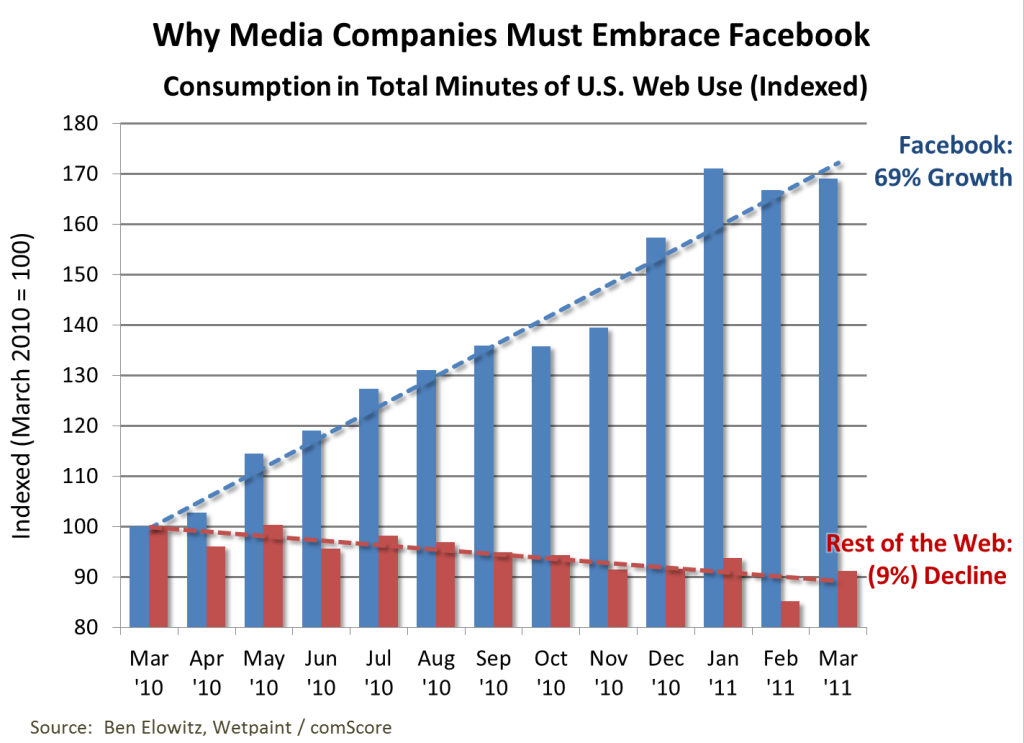
As I’ve been saying, Google is seriously limiting itself – and its future – by sticking with its anonymous algorithm and not finding more significant ways to take advantage of the fast-growing Social Web. Google is also coming under intensifying pressure from Facebook, which is the de facto operating system of the Social Web and increasingly taking share from the searchable web, Google’s previously dominant domain.
If the FTC leans on Google, the company could find itself pinned down in a crippling – or at least debilitating – three-front war. On one battlefield, it would be forced to fight the Federal government; on another, it would be required to grapple with Facebook, which is establishing Social Web supremacy; and then, on a third, a suddenly more limited Google would have to contend with increased competition in search from Microsoft’s Bing.
I like Google CEO Larry Page, but he’s hardly the digital equivalent of Napoleon or General George Patton.
The real question here, though, is whether Google is stuck in search, or whether it can innovate into new markets, social and otherwise.
In some ways, Google’s potential conflict with Washington D.C. is reminiscent of the mid-1990’s, when The Department of Justice alleged that Microsoft engaged in exclusionary (and anti-competitive) actions in the browser market as part of its efforts to maintain muscle in personal computer operating systems. The resulting legal action distracted Microsoft and required a good deal of time and energy that might have been better spent innovating for the surging Internet. And what’s even worse, many saw the ordeal and ensuing similar European legal wrangles as tipping a cultural mindset change from one of fiercely aggressive growth to one of cautious bureaucracy. And that cultural change that seems to have kept the company out of pretty much all the greatest technology growth markets of the last decade.
No one knows if a similar fate awaits Google. But, in any event, it’s becoming quite clear that “more of the same” isn’t going to allow Page & Co. to continue their success of the last decade into the next.
Facebook is the social king today, but Google doesn’t have to give up on the Internet’s future.
Google is confronting a series of rugged (and, perhaps, ultimately insurmountable) challenges. And make no mistake: these challenges loom large, because Google’s dominance of the Internet landscape is increasingly being threatened by Facebook’s rise.
If Google (GOOG) is going to maintain its leadership, still-new CEO Larry Page needs to have a plan for the social Web. And, as the new CEO, he’ll need investors to be confident that he’s got this handled.
There are four things Page could do to renew Google’s dominance:
1. Admit that Google has a problem.
Page needs to acknowledge to his employees the enormous threat posed by the socialization of the Web: already, 25 percent of all page views on the Internet are not only social, but served by Google’s enemy, Facebook; meanwhile, Google has no significant share whatsoever in any social activity. Google’s CEO should also be declaring to his employees that Google’s next life stage must be fully social. In addition, Page must offer analysts a more substantive and authentic message. When Google’s senior executive team sweeps its social Web weakness under the rug, Wall Street isn’t fooled. And Page’s silence doesn’t stop the tough conversation from happening. Indeed, in this age of investor sophistication and watchfulness, admitting neither problems nor opportunities only heightens the fact that the CEO isn’t taking his business seriously. Page could have preempted the hard-edged conversation with his analysts recently by proving that Google is ready to fully participate in the opportunity presented by the social Web. If framed well, and backed by demonstrative action, this could even help to highlight the potential upside in Google’s future, and that’s always a positive when it comes to dealing with the Street.
2. Show Google understands how the Web is changing.
Facebook isn’t just another really popular Web site. Rather, the entire nature of the Web has been transformed from a bunch of pages on servers that Google crawls, to the world’s people connected to each other and sharing their lives. Just as significant, more and more of the Internet’s capabilities are delivered via apps, rather than on HTML forms. Gone are the days when Web developers would make everything HTML-compliant just for Google’s sake, while end-users had forgivingly low bars for their own experiences. Now, customers must come first to publishers – and that means providing them with content when, where, and how they want it in the social networks, in video, and on mobile devices. Page needs to clearly show that he understands the “ground rules” of the new Web; then he needs to lay them out crisply, with their differences distinctly noted, so that his business units – from the moneymakers of search and advertising to the experiments in social media – can start remaking themselves accordingly. Gmail, for example, should be reinventing communication for a fully connected world in which email usage is on the decline, just as it reinvented the category when email was still on the rise seven years ago; and Google Apps needs to rethink how applications can be so much more than mere Microsoft Office stand-ins when its users are connected to the Web most of the time.
3. Recruit hard for new talent.
It’s not enough to rotate the deck chairs and the bodies that sit in them; it’s time for Google to parachute in some rescuers. For example, Google needs to win notables like Vadim Lavrusik, who just joined Facebook, to help guide social content in news and media; and it also needs to remake its employment proposition to attract the up-and-coming stars like those who have joined Facebook, as well as those who have started their own companies. Google developed an amazing human resources formula that attracted a slew of talent to fuel the search wave; but now the talent wars are underway, and Facebook’s pre-IPO buzz has leapfrogged over Google’s gourmet chef and personal training perks to attract the best and the brightest. Google needs to reinvent its formula and demonstrate a winning strategy to attract the next generation of stars.
4. Show your work on social.
Finally, Page should be demonstrating progress on a host of new, socially supercharged products and ideas that Google desperately needs right now. In addition to pulling from the outside, the company should be incubating its own ideas to take advantage of the social Web. Page’s incentive compensation plan is a start, but it doesn’t go nearly far enough to light a fire that will help Google out-compete Facebook, a private company that has already garnered nearly 50 percent of Google’s own market capitalization – without having even signaled an entry into the search marketplace yet. Google’s home turf of search is uncharted territory for Facebook, but, just as importantly, the social terrain has already proven a minefield for Google. Page should be working on these four items each and every day. But he should also be communicating his progress in these areas on an ongoing basis to investors and analysts, as well as employees. And, as for how, the outreach needs to be personal. He’s Google’s CEO; it’s his responsibility; and it’s an integral part of the top job – a job, by the way, that he recently chose to assume and shoulder.
In his debut earnings call with investors, Page made nary a mention of social. By sweeping the social Web and his new chief competitor under the rug, Page seemed to be making the false assumption that the analysts and media covering the company wouldn’t notice the rising force of social or Google’s lack of social progress. Of course, nothing could be further from the truth, because Facebook’s $78 billion valuation represents a lump beneath the rug that’s nearly the size of Mt. Rainier.
Google can’t just ignore this mountainous marketplace impediment. And investors aren’t the only ones that take notice of Google’s lack of strategy here: the engineers coding Google’s products need to know that their leaders want to attack, not ignore, the mountain.
Markets go up, and markets go down. But opportunities like the social Web come along only so often. So, if Page and Google remain radio silent on Facebook’s clear and present threat, they’ll be frittering away much more than their market cap. They’ll be gambling with their greatness. And that would be a huge mistake.
For a company that has sworn it’s a communications utility, and not a media company, Facebook sure does have some outstanding media talent on its Board of Directors.
Included, of course, is The Washington Post Company’s Don Graham, who is successfully bridging the print and digital generations.
And Now Reed Hastings of Netflix.
I’m wondering whether Mark Zuckerberg has changed his mind, or whether something different is going on.
And, as I’m thinking over what an increasingly social world means, I’m asking myself whether a communications utility is really any different from a media company.
The answer may be “no.”
Here’s why: Increasingly, the “distribution” part of media is being handled by lots of point distributors, each passing along to their own network, rather than by big companies that own dedicated equipment or spectrum like newspapers and broadcasters did.
And, as for content creation, we all know it’s gone from an oligarchy of anointed editorial sources to legions of content creators and commenters.
For Reed Hastings, he has a ton to learn from Zuckerberg about how to re-imagine content creation and distribution. But Hastings, for his part, can help Zuckerberg learn how to rapidly build and scale a powerful business model that is increasingly playing in the world of content.
After all, no matter how Facebook likes to think of itself, it’s increasingly in the business of connecting audience to content.
So, that pretty much makes it a media company.
However the company defines itself, though, it’s clear to see that Facebook is playing a key role in digital media’s evolving model. And it’s a smart of Mark Z. to learn from Hastings – who is one of the best in the world at innovating to serve today’s consumers in new and untold ways.
The upside of all the data that can be collected about us on the social web today is that we can increasingly get better and more relevant information faster.
But there’s a dark side that Brian Stelter reported on this week in The New York Times – all that data can leave us exposed.
There’s no question that the benefits of a connected world are immense; but, after reading Brian’s probing piece and taking a big gulp, I recognize that it also means we’ll see more abuse.
The new information exchanges, marketplaces, and networks we are building online have huge power because they connect so many disparate people and things together. That’s the appeal; and it’s also the genesis of the inherent potential for misuse.
In previous Web generations, newsgroups, eBay, and Craigslist offered people extraordinary new dimensions of information, commerce, and connection. And we saw a small – but harmful – percentage of misuse.
And yet, the bigger surprise to me isn’t that these exchanges can be exploited, but that they work at all. Whether they’re propelled by financial or ego-centric motives, the nefarious exploiters seem to be outnumbered twenty-to-one or more, and the exchanges largely work in spite of them.
Lately, I have been thinking and writing a good deal about the divergent approaches that Facebook and Google have been taking when it comes to the Web.
It’s clear that Facebook is a world filled with identity – and with a vast network where every node is identified comes unprecedented personal risk. Do I really want my friends, my enemies, my government, and worse, my mother, to connect all the dots of my existence?
No, most assuredly not.
And yet having my identity established online offers enough payoffs that I permit it.
Increasingly, Facebook has been pushing for the benefits of an identified and networked world; at the same time, Google has established itself as the king of the anonymous Web. The result is that Facebook finds itself in one privacy imbroglio after another; and I’m sure more are on the way.
But while Google scans the pages of the Web without any sense of human identity, its former CEO rues that they have missed out on the benefits of the social Web as a result.
We’re definitely walking a fine digital line here.
But my money is on an increasingly social Web; and we’ll clearly have to address the downsides as we tip-toe – or barrel – into the future.
A couple of weeks ago, here in Seattle, I had the opportunity to participate in a discussion about the future of SEO (search engine optimization) and SMO (social media optimization), along with one of the top SEO experts in the world: Rand Fishkin. The conversation was a lively one, moderated and reported –by Curt Woodward, at Xconomy.
My view is that – particularly for media – we are at a tipping moment. The web is no longer a field of static documents navigated by a precise search engine. Instead it’s a living organic distribution machine from person to person, through the ether of “social operating systems” like Facebook and Twitter. And, as a result, I expect Google will be losing ground to Facebook.
It’s was a lively and fun dialogue.
Read the highlights and play-by-play here, courtesy of @curtwoodward.
Microsoft unveiled its first preview of the Windows 8 user interface at the All Things D D9 conference last week. It was a thrill to see it. And my first reaction was that it looks more like media than software.
But upon further reflection, it’s more than just Microsoft. It’s been the theme of the recent wave of operating system overhauls on mobile devices, which are now taking root on the desktop, too. It’s happened on the iPad, on Palm/HP’s WebOS, and now finally on Windows’ mainstream interface. User experiences are showing more design heritage from print and media, and less from software roots.
It’s an important marker. Going back decades to the beginning of the personal computing revolution, software was written by programmers, who were doing their best to make machine instructions controllable by end users. It was an inside-out approach: starting with the microprocessor’s constraints and translating them into displays that were at least interpretable by end-users.
Now, programmers have the luxury of fast processors, sophisticated graphics systems, and advanced libraries – not to mention the development of the new field of user experience. So, instead of starting with microprocessors and asking users to adapt, we are seeing design go the other way: we are starting with real people (consumers) and making the software conform to them.
When we do that, the “a-ha” to me is that the consumer-first approach is a media approach, not a software approach. It doesn’t start with the machine; it starts with the audience. And that’s exactly what the expertise of media is. The result culminated in Steve Sinofsky’s demo of a complete overhaul of Windows 8’s interface, that looks so much like a media property, and not so much like any desktop software interface that we are used to. Indeed, the “desktop” metaphor of previous generations of Mac, PC, and Unix interfaces is blown up entirely, replaced by a start screen with so many content tiles, each formatted richly and compellingly in a glossy, high-production-values sort of way
The future of software is looking a lot like media.